
Emergent: build an app with AI, no code
What Emergent is, how to build a full application with AI without writing code, what the credit pricing costs, and when this approach actually makes sense.
Building software is no longer reserved for people who write code. A new generation of tools lets you describe the application in plain language and watch the AI generate the code, the interface and the database. Emergent is one of those platforms, and it has picked up real traction — it raised $70 million in a Series B at a $300 million valuation. This guide covers what Emergent is, how to use it, what the credit-based pricing actually costs, and, more to the point, when building this way makes sense — so you do not mistake ease for strategy.
What Emergent is
Emergent is an AI app builder aimed at people without a technical background. You describe, in natural language, what the application needs to do, and the platform generates the full stack — front end, back end and integrations — automatically. It is what the market has started calling agentic development: the AI does not merely suggest snippets, it carries the build end to end.
The promise is that a non-technical founder can go from an idea to a working application without hiring a development team for the first prototype. That changes the economics of testing an idea: the cost of validating drops sharply.
Building software got cheap. What is expensive now is deciding what is worth building.
How to use Emergent in practice
1. Describe the application clearly
Everything starts with the prompt. The more specific you are about what the app does, who it is for and which screens it needs, the better the output. Write it as if you were briefing a developer: the objective, the user flow, the data involved.
2. Iterate in increments
Emergent works through actions that consume credits. Small adjustments cost little; complex changes cost more. In practice the efficient path is to build in parts: the skeleton first, then each feature, testing at every step. That avoids burning credits redoing everything.
3. Test and refine
After each generation you test the app and ask for adjustments in natural language. It is a conversational loop: you describe what is wrong or what is missing, and the AI corrects it. That back-and-forth is the heart of the process.
4. Ship and evolve
Once the app reaches a usable minimum, you can publish it and keep evolving. For many businesses the value is precisely in having a working MVP quickly, to validate with real users before investing heavily.
See it in practice (video)
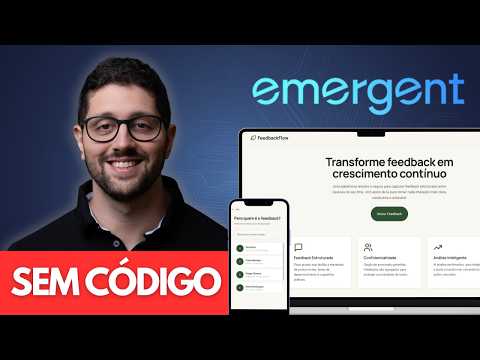
I recorded a full walkthrough building an app with Emergent without writing a line of code. The video is in Portuguese, but the entire build is on screen and the interface is in English.
What Emergent costs
Emergent runs on credits: every AI action consumes credits, and more complex actions consume more. Prices as of July 2026 (annual billing takes 15% to 17% off).
| Plan | Price/month | Credits |
|---|---|---|
| Free | $0 | 10 credits (to try it) |
| Standard | $20 | 100 credits |
| Pro | $200 | 750 credits |
| Team | $300 | 1,250 shared credits |
The free plan, at 10 credits, is enough for a prompt or two — not for building anything complete. For a real project, Standard is the realistic starting point, and consumption grows with the complexity of what you build.
When building with AI makes sense (and when it does not)
Building with AI is excellent for:
- Validating an idea fast. Going from concept to a working prototype in hours rather than months.
- Internal tools. Apps for internal use, forms, dashboards, operational flows.
- MVPs. Testing a product hypothesis at low cost before committing to custom development.
Think twice when:
- The system is critical and has to scale. Applications that will carry the core of the business, with many users and security requirements, still call for careful technical review.
- The problem is not software. Sometimes the real pain is a process or a decision, not an app. Building an application does not fix an undefined process.
The question that separates a good call from wasted money is not "can I build this?" — it is "does this solve the right problem?"
Frequently asked questions
Do I need to know how to code to use Emergent?
No. The platform is designed for people without a technical background. You describe what you want in natural language and the AI generates the code. A sense of logic and of user flow helps you write better prompts.
Is Emergent free?
There is a free plan with 10 credits, enough only to try it. To build a real application you need a paid plan, starting at Standard ($20/month).
Emergent or traditional development?
It depends on the objective. For validating ideas, building MVPs and internal tools, Emergent is faster and cheaper. For core, critical, large-scale systems, development with proper technical review is still safer. The usual best path is to start fast with AI to validate, and invest in custom work only after the hypothesis proves out.
Conclusion
Emergent puts software construction within reach of whoever has the idea, not only whoever can code. That is a genuine shift in the economics of testing a hypothesis. But ease of building does not remove the harder question: what is worth building, and in what order. That clarity is what, in my consulting work, comes before any line of code — generated by AI or not.
To try it: create your Emergent account and start on the free plan.
If you have an idea for a product or an internal tool and want to decide the right path before building, that is where a strategic diagnostic starts.
Sources
Apply
Want to apply this in your business?
A complimentary conversation to understand your context and decide, together, whether it makes sense to move forward.
MVP: como validar uma ideia de negócio
O que é um MVP, como usar para validar uma ideia de negócio com baixo custo antes de investir pesado, e os erros que fazem o MVP virar só um produto capado.
Funil de vendas: como estruturar e automatizar
O que é um funil de vendas, como estruturar as etapas do primeiro contato ao fechamento, e onde a automação ajuda a não perder lead pelo caminho.
Como Criar Aplicativos com IA Sem Programar: Guia Estratégico
Aprenda como criar aplicativos com IA sem código. Conheça as melhores ferramentas no-code e o pensamento de produto por trás de cada decisão.